Showing posts with label Videos. Show all posts

Dolphin invents new way to breathe ?

0

This dolphin has invented a way to overcome a disability

It should not be able to breathe because its blowhole is blocked, but it has devised a way around the problem

Dolphins usually breathe using their blowhole. But it now seems this is not a hard-and-fast rule. For the first time a dolphin has been spotted breathing through its mouth.The finding reveals that dolphins can adapt their behaviour, as you can see in the video above. "It demonstrates the behavioural flexibility of these animals," says lead author Stephen Dawson of the University of Otago in New Zealand. "It has invented a novel work-around to circumvent a disability. However, the process is a bit clumsy, and clearly is nowhere near as efficient as the normal mode of breathing."


Read More »

Patrick Hardison: One Year After Rare Face Transplant

0

Severely Burned Firefighter Gets Face Transplant That Changes And Renews His Life 

Mississippi firefighter Patrick Hardison was 27 in 2001, when the roof of a burning house collapsed on top of him. For 14 years, he battled pain, stares from strangers and a loss of hope. Finally, he has found hope again when he gets a face transplant.


Read More »

Florida Woman Keeps 2 Bengal Tigers In Her Garden!

0

Woman Keeps Two Tigers In Her Backyard – And They’re As Loving And Playful As Kittens!

While most people spend their golden years relaxing in their garden Janice Haley chooses to hand feed the two man-eating tigers she keeps in hers. Saber -- a 600 pound white Bengal male and Janda -- a 400 pound orange Bengal female live in a cage at the back of Janice's unassuming suburban home. Each day Janice, 57 hand feeds the gentle giants and Saber -- the baby of the pair - can't get off to sleep without suckling on her finger. She happened upon her extraordinary life around 20 years ago when she quit her job as an admin assistant to spend more time working outdoors.
After spotting an ad for a tiger training course in her local paper she applied and two years later arrived home with Chuffer the tiger cub. She was immediately BITTEN by the tiger bug and in 2002 bought Janda -- who is now 12 -- to live with Chuffer. After Chuffer's death in 2007 little Saber -- who was only two weeks old at the time -- was introduced to the enclosure -- much to the annoyance of Janda. Tigers are fearsome jungle cats that are near-universal symbols of ferocity, strength and courage, but 57-year-old Janice Haley of Orlando, Florida has a different perspective on the matter. To her, they’re also cuddly kitties. When you see her play with her two pets, 400-pound Bengal tiger Janda and 600-pound white Bengal tiger Saber, you’ll understand why – they’re about as loving and playful as their tiny domesticated cousins.


“As far as they’re concerned, I am mommy,” explains Haley. “They rub me in the face, they’ll let me kiss them on the nose.” The two tigers live in an enclosure in her backyard and are fed by hand 3 times a day.

It all began in 1995, when Haley decided to quit her boring desk job and, at her husband’s advice, begin working with exotic animals. She has had quite a few different big cats since then, and plenty of volunteers to help take care of them and play with them as well.

“People who consider it cruel to keep them in captivity have a point, to a point,” conceded Haley. “It is not the ideal place for a tiger to be, in a cage. But at this point, in the wild, there isn’t a lot hope out there for them anymore, and if there aren’t some of them left in cages there aren’t going to be any left at all in a couple of years from now… They are provided for and loved here. In my opinion, I wouldn’t mind being a tiger in my backyard.”


Read More »

Can a computer copy your handwriting?

0

Researchers at University College London have taught a computer to imitate anyone's handwriting.

They have created an algorithm that can take a sample of handwritten text, examine its qualities, and then write any text in the same style.There are already typefaces in word processing programs that produce text in a fairly uniform handwritten style. But what Tom Haines and his fellow UCL researchers have done is create software that they claim reproduces the messy details of any individual writer's hand.They call their system My Text In Your Handwriting and have tried it out on samples of handwritten text from historical figures such as Abraham Lincoln and the creator of Sherlock Holmes Sir Arthur Conan Doyle.While Conan Doyle never actually wrote "Elementary, my dear Watson..." the UCL team have now produced that sentence in his handwriting.


Handy writing

I gave Tom Haines a uniquely difficult challenge.My handwriting has always been bad. A messy scrawl that even my family struggles to decipher. I supplied Tom with a sample written on paper with a ballpoint pen - other programs have relied on text written on a tablet, which gives a less accurate input.He began the process by using a program that marked up each letter and punctuation mark, analysing in some detail how I wrote. The fact that I sometimes dotted the letter i and in other cases did not was just one wrinkle.Then when the analysis was complete he fed it into the algorithm and typed the word "hello" into a box.Alongside, a barely legible "hello" appeared - but I had to admit it was a fair approximation of my scrawl. We then tried it out with a whole sentence - and again I have to admit the result was just as bad as I might have produced. Clever - but what practical uses does this handwriting algorithm have?One example is where banks send out sensitive documents or new credit cards and want to disguise the letters so that they look like handwritten personal letters. The researchers showed me three hand-addressed letters - one of them produced by the computer, two genuinely hand-written. I struggled to work out which was which - see if you can do any better.

 Is this by human hand or a computer? (Answer at the foot of the page) 

 Or this one?

 Does this look real or has it been penned by silicon? 

Another possible commercial use is in the personal messages that are inserted with flowers or presents sent by delivery firms - how much better to have a "genuine" handwritten "Happy Birthday" than something typed on a card.You might think that another potential use was by criminals attempting to forge your signature. But the researchers say that close examination with a microscope will still reveal what was written by a real human being and what was machine-generated.

* Image 2 was done by computer but the other two were written by a human.


Read More »

Accident Destroyed her Face, After 11 Years She Gets Prosthetic Face!

0

Blind Mom Gets Prosthetic Face!


For 11 years, Chrissy Steltz had been living without a face.
After an accident with a shotgun destroyed her face and left her blind, Steltz made incredible strides toward living a normal life. She learned to read Braille and use a cane. She met her boyfriend in a school for the blind. And she gave birth to a son on July 23, 2009. Despite her full life, there was still one thing that Steltz felt she was missing: a face for her young son to look into. To cover her injuries, the 27-year-old wore a black sleeping mask.
Now, with the help of a team of generous doctors and advances in technology, Steltz finally has been given a new prosthetic face. Doctors used photographs of her at 16 and aged her features to reflect the 11 years that have passed since the accident. Steltz believed the prosthesis would make her feel better about herself. Despite her blindness, she always has been able to feel the stares of others.
But more important to her than self-confidence, Steltz said she wanted the prosthesis "so my son can grow to know his mom looking like a regular person versus a sleep shade."

Video:


The Accident :In March 1999, Steltz and her live-in boyfriend, Will O'Brien, threw a party at their home, where some of their friends were drinking. Someone found a stolen shotgun under the sofa and began to fool around with it. The last thing Steltz would hear before the blast went off was, "Oh, don't worry. It isn't loaded." The gun went off and took two-thirds of Steltz's face with it.  Steltz Wakes Up Without a Face. Her boyfriend came in the room shortly after.
"I don't know if you have ever seen like a wounded animal trying to get up," O'Brien recalled, "That's what I saw. I saw an injury that nobody survives, except somebody really strong, and she was trying to get up."
Steltz was rushed to the hospital, where she first encountered Dr. Eric Dierks, a maxillofacial surgeon. 
She went into a coma and was hospitalized for six weeks. She had no idea what had happened to her once she regained consciousness. O'Brien broke the news to her that she never again would see or smell. She would also lose part of her hearing and her taste.
According to Dierks, "The blast itself removed the contents of her left eye socket, removed her nose and the supporting mid-facial structures and damaged her right eye to the extent that she lost vision." 
Steltz still lives with dozens of pellets from the shotgun blast lodged so deeply in her brain that they never can be removed.  The blast removed Steltz's eye sockets and sinus cavity, making prosthesis a better route than a face transplant. Undeterred, she worked with doctors to find a solution by rebuilding portions of her hollow bone structure, the first attempt at this type of operation for an injury as extensive as hers.
"It's unique to have an injury of this magnitude to the middle part of the face that removes the vision of both eyes, that removes the nose yet allows the injury to the base of the brain to heal," Dierks said. 

Doctors removed damaged tissue, opened a breathing passage to her nasal cavity, drilled dental implants into her facial bones to fix magnets to the tips. They used bone from her right leg, skin grafts and dozens of screws and metal plates so that her prosthetic face could snap on and snap off.
The prosthesis itself was the work of maxillofacial prosthedontists Dr. Larry Over and Dr. David Trainer. They began by creating a plastic mold of Steltz's face. Next, they poured flesh-tone silicone into the mold to form the facial features. It was baked to seal in texture and color, and then painted to reflect the natural flaws of the human skin.
The doctors also ensured Steltz's face came complete with makeup: They baked eyeliner, eye shadow and mascara directly into the mask and poked eyelashes into the silicon with tweezers. They took care to ensure the results were as real as possible.
Getting the eyes down was of monumental importance, Over said.
"If you drew a clock around the colored portion of the eye ... is that little glint in the same position in the left as it is on the right?" he asked.  Steltz's procedure cost nearly $80,000, according to Dierks, but her health insurance refused to cover the cost, saying hers was an aesthetic procedure.
"This is certainly not a veneer on a front tooth," Over said. "It's just as much of a medical necessity as an arm or a leg." The doctors and staff who worked to reconstruct Steltz's face donated their time and services so that Steltz could have a face.
The results?
Friends and family gathered to witness the reveal of her new face at the doctor's office. Steltz's friends and family broke into tears. It was the first time she had seen her daughter's face in more than 10 years.  Later that afternoon, in a more familiar setting, Steltz revealed her new look to her son, who's only ever known his mother's face in a black sleeping mask.
"It's going really well," she said. "He's not minding it one bit."
Steltz thinks her year-old son actually sees his mother now when he looks at her new face.
Steltz said she also feels like a regular blind person now. Armed with her new look, she went out on a recent shopping trip with her sister and was delighted to discover she no longer felt the stares of strangers.
"To be looked at as a plain Jane," Steltz said, was exactly what she wanted -- "to be treated just like everyone else."


Read More »

Shocking video - lion attacking a baby on live TV!

0

Lion attacks toddler on LIVE Mexican TV Show, tries to snatch child form mother's arms!

 
This is the terrifying moment a baby is attacked by a lion on live TV as handlers desperately try to prise its jaws open.
The incident, which very nearly ended in disaster, occurred during the filming of former Mexican programme Con Sello de Mujer.This clip from the show, which was last broadcast in 2007, recently went viral after re-appearing online and features a toddler and a lion cub in the TV studio.
The child was not harmed.


At the start of the video everything looks to be under control as two handlers sit with the wild animal on a lead and talk to the show's presenter. In between the two parties is a mother, who holds her young daughter in her lap. The lion cub sits on the floor and appears to be quite calm until the baby starts to whine - a sound that sends it into a frenzy. Without warning, the lion suddenly jumps to its feet and lunges at the little girl, grabbing hold of her leg with its sharp teeth. The attack causes the baby to scream in terror, which only aggravates the situation as the female handler calls for calm.
The trainer can be seen wrestling with the lion's face while trying to force it to let go of the child. Meanwhile the toddler's mother, who appears shocked, pulls her baby towards her as the lion tugs her leg the other way.
Eventually the two trainers are able to prise the lion's jaws open and pull the little girl's leg free.The male trainer then heads off with the cub as the woman pulls the baby's trousers up and gives her a hug.The clip concludes with the handler then giving the mother a hug to apologise for the incident.Con Sello de Mujer was a show primarily aimed at women. It ran from 1998 to 2007 and touched on topics including health and beauty.
Read More »

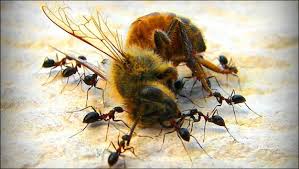
Honeybees are dying... The Consequences are fatal!

0

THE DEATH OF BEES!


The bees are still dying in masses. Which at first seems not very important until you realize that one third of all food humans consume would disappear with them. Millions could starve. The foes bees face are truly horrifying – some are a direct consequence of human greed. We need to help our small buzzing friends or we will face extremely unpleasant consequences.


Colony collapse disorder (CCD) is the phenomenon that occurs when the majority of worker bees in a colony disappear and leave behind a queen, plenty of food and a few
nurse bees to care for the remaining immature bees and the queen. While such disappearances have occurred throughout the history of apiculture, and were known by various names (disappearing disease, spring dwindle, May disease, autumn collapse, and fall dwindle disease), the syndrome was renamed colony collapse disorder in late 2006 in conjunction with a drastic rise in the number of disappearances of western honey bee (Apis mellifera) colonies in North America. European beekeepers observed similar phenomena in Belgium, France, the Netherlands, Greece, Italy, Portugal, and Spain, Switzerland and Germany, albeit to a lesser degree, and the Northern Ireland Assembly received reports of a decline greater than 50%. 

Colony collapse disorder causes significant economic losses because many agricultural crops (although no staple foods)
worldwide are pollinated by western honey bees. According to the Agriculture and Consumer Protection Department of the Food and Agriculture Organization of the United Nations, the worth of global crops with honey bee's pollination was estimated to be close to $200 billion in 2005. Shortages of bees in the US have increased the cost to farmers renting them for pollination services by up to 20%. 
In the six years leading up to 2013, more than 10 million beehives were lost, often to CCD, nearly twice the normal rate of loss. Several possible causes for CCD have been proposed,
but no single proposal has gained widespread acceptance among the scientific community. 
Suggested causes include: infections with Varroa and Acarapis mites; malnutrition; various pathogens; genetic factors; immunodeficiencies; loss of habitat; changing beekeeping practices; or a combination of factors. A large amount of speculation has surrounded a family of pesticides called neonicotinoids as having caused CCD.
Honeybees perform some level of pollination of nearly 75% of all plant species directly used for human food worldwide. Catastrophic loss of honeybees could have significant impact, therefore; it is estimated that seven out of the 60 major agricultural crops in North American economy would be lost, and this is only for one region of the world. Farms that have intensive systems (high density of crops) will be impacted the most compared to non-intensive systems (small local gardens that depend on wild bees) because of dependence on honeybees. These types of farms have a high demand for honeybee pollination services, which in the U.S. alone costs $1.25 billion annually.This cost is offset, however, as honeybees as pollinators generate 22.8 to 57 billion Euros globally. 
Read More »

10 Cheaters in Olympic Games!

0

10 Olympic Athletes Caught CHEATING!

Cheating has been a part of the Olympics Games since its creation. Individual players, coaches, even entire teams have been caught trying to up their advantage in one way or another. As the saying goes however, cheaters never prosper and at some point they are caught. At best they lose their standing or their metals. At worst, they are barred from participating at the Games for years or for life. Some wonder if the risk of being caught even makes the cheating worth it. Maybe they feel they will never be caught, that they can somehow slip under the radar and have their moment in the spotlight. In an event as big as the Olympics, there’s nowhere to hide and eventually the truth will out.
In every professional sport there is an aspect of cheating. Whether disqualified for doping or discredited for bribing the judges, in the end cheaters never really win. Here are ten Olympic Games cheaters from over the years.

Read More »

Forget selfies - this is South Korea's latest photo craze.

0

South Korea's 3D photo craze 

Forget selfies - this is South Korea's latest photo craze. Life-like three-dimensional figurines are the talk of the town here.South Koreans have caught on the latest trend in capturing the images of their loved ones in 3D.


Read More »

All She Needed Was Just a Hug!

0

Edie was labeled aggressive in a high kill shelter and was saved from euthanasia at the last hour. This is her story.


Shelter dog Edie was schedule to be euthanized. She was fearful, aggressive, and hard to control. Then Bronwyne Mirkovich gave her another chance as he and Eldad Hagar recorded the process on videos.

-Part 1-

Edie is rescued!


 -Part 2-

Edie has a new family!


There are too many animals and not enough homes. Shelters have been facing a pet overpopulation problem for the last few decades. Some animals are found wandering as strays, and some are surrendered by their owners who cannot, or no longer want to, care for them. 

In order to help reduce pet overpopulation and being part of the solution, it’s important to have your pet sterilized, which is the only permanent, 100-percent effective method of birth control. In most shelters, spaying or neutering is mandatory for all adopted cats, dogs and rabbits. This ensures the animals placed in the community don’t contribute to pet overpopulation.
Shelters are overcrowded. Adoption will not only save the life of the pet you are adopting but will also make room and free up precious resources for another animal that the shelter will take in. Adopting an animal from a shelter is the best way to help the shelter continue its work. Shelters are meant to only house animals temporarily, and in order to be able to help more animals in need, shelters must find loving adoptive homes for the animals they take in.


Shelters are full of healthy, sweet and smart animals who were surrendered not because of their behavior but generally due to the issues of their guardians. The most common reasons animals are surrendered is because of a change in circumstances of their family: a divorce, a move, a new baby or because their family was not ready for all the responsibilities of having a pet and “no longer has time for them”. Shelters and rescue groups offer adoptable dogs, cats and many other animals of all ages, breeds, mixes and sizes. 
Adopt an animal - Save a life!
Read More »

Animal Hell In Mississippi!

0

Animal Rescue Team discovered Animal Hell In Mississippi! 


What HSUS' Animal Rescue Team discovered on a Marion County Property left some haunting memories and some hope for over 200 animals rescued from deplorable conditions.
Dozens of animal advocate groups teamed up with the Marion County Sheriff's Department to save more than 120 animals from a property on Smith Hill Rd. in Marion County Wednesday. There were more than 200 animals on the property. By the end of the day 120 were pulled out alive with several dead animals on the property. 

Officials were alerted to the animals when neighbors started complaining about some of the animals escaping the property and grazing on their land. When deputies witnessed the conditions the animals were living in they contacted the Humane Society of the United States for assistance.
"We're finding a lot of the animals have been severely neglected for a long time,"said Lydia Satler, State Director, HSUS. "They are not getting basic care, a lot of the animals have real long hoofs, and we have deceased animals on the property."
The list of animals included more than 50 miniature horses, full size horses, goats, sheep, mules, turtles, and dozens of cats and dogs. Some were in pens or cages and some were left to roam the several acre property. Temporary shelter has been arranged for animals until a more permanent solution can be found.
"We're going to get this done today, however long it takes to get all the animals off the property. We'll get them to the shelter and at that point they are going to receive more extensive medical treatment and care." 
Satler added it took a lot of planning and resources to put the rescue operation together. HSUS Animal Rescue team Members were brought in from around the country and locally several animal advocate groups pitched in to help.
Assisting with the rescue: The Marion and Rankin County Sheriff's Departments, and volunteers from the Hub City Humane Society, Southern Pines Animal Shelter, Mississippi Animal Rescue League, Trails End Horse Haven and several other volunteers.  
Authorities say charges are pending against the owner.


Read More »

Newborn monkeys smile in their sleep just like babies do !

0

Newborn monkeys smile in their sleep just like babies do !

For the first time, baby Japanese macaques have been seen spontaneously smiling.


When a newborn baby appears to smile for the first time it is perhaps one of the most rewarding experiences a new parent has.Of course, the baby is probably not smiling in response to a social trigger. An apparent "smile" in the earliest days might simply be an unintentional change in facial expressions. In 1959 a researcher called Peter Wolff called these "spontaneous neonatal smiles". They involve, he wrote, a "slow, gentle, sideward, and upward pull of the mouth, without rhythmical mouthing movements or contraction of other facial muscles".In fact, this type of spontaneous smile often happens during sleep. However, the cause of these neonatal smiles is unclear.

 Japanese macaques show many different expressions 

We now know that humans are not alone in this seemingly innate reaction. A decade ago it was discovered that chimpanzee babies show similar spontaneous smiles.Chimps are one of our closest living relatives in the animal kingdom today. As we share a common ancestor with them, which lived between six and 13 million years ago, the finding suggests that smiling goes back to at least that far.A team led by Fumito Kawakami of Kyoto University's Primate Research Institute in Japan, has now discovered that spontaneous smiles go back even further. "Infant Japanese macaques are super-cute and their facial configuration is almost the same as humans," says Kawakami. "So when I observed this smiling in an infant macaque, I simply thought 'oh this is the same as humans'."

 Spontaneous smiles often occur during irregular sleep or drowsiness

After noticing some smiles while performing health checks on the macaques, he wanted to uncover whether it was more common.To do so, his team monitored seven newborn Japanese macaques. They all showed spontaneous smiles at least once, within an hour of observation. In all cases they were in a state of REM (rapid eye movement) sleep.  The monkeys ranged in age between four and 21 days old. In all, they produced a total of 58 spontaneous smiles. This suggests that these smiles are not rare, the researchers say."If we can observe the same behavior in more distant relatives [such as] Japanese macaques, we can infer that the origin of smiling goes back to around 30 million years," Kawakami says. In turn, this can help us to understand more about spontaneous smiling in humans.

 Neutral (top) versus spontaneous smiles (bottom) in Japanese macaques 

Kawakami and colleagues have published their observations in the journal Primates.This research shows that the first developmental stage of smiling is shared by humans, apes and monkeys. "After that, only humans use those facial expressions in various contexts," says Kawakami.The finding also implies that smiling is innate, which would make sense as it is so fundamental to our social world.Japanese macaques are only the third species observed producing these neonatal smiles. But that does not mean the smiles are unique to these species: it may simply be that nobody has yet noticed other species producing them. "There are case reports about mice laughing when they get tickled and dogs displaying facial expressions of pleasure," says co-author Masaki Tomonaga. "It may be the case that many mammal infants display spontaneous smiles, in which case smiling would have an older evolutionary origin."

 Chimpanzee infants also show spontaneous smiles


Read More »

Heroic People Who Saved Animals Lives!

0

Real Life Heroes, When people help animals!


Our relationship with animals is complicated. For millions of years, humans have cohabited the Earth with animals and have had them be our best friends, our meal, and our feared enemy. There are thousands of different animals in the animal kingdom from pets like cats, dogs, birds, etc. to animals we keep in zoos and try to rescue from extinction. And then there are animals that we try to stay as far away from because they could be threats to our safety and our very life. But no matter what, we still love animals, and some love them to a point to where they participate in animal activism and refrain from eating animal products as a sign of solidarity.
We still depend on animals for our survival, whether we are consuming them, or using their resources for clothing and shelter. Thus our place in the animal kingdom is still dominant until we come to an age where we no longer need them and hopefully let them live as they should. But with the alarming rate of animals going extinct, we might have to learn to live without them soon.
In this video are several heroic people who put their own lives on the line to save the life of an animal. These people have been hailed as heroes in their towns and became celebrities known around the world for their heroism. It’s one thing to save a human, but to put it all on the line to save the life of an animal that will likely never return the favor is the prime example of heroism and humility. While some people may consider these heroes foolish, others think of them as honorable.
Read More »

Family of Bears Enjoys Outing at California Lake

0

Family of Bears Enjoys Outing at California Lake

A family of three bears was spotted recently bathing in the waters of Lake Tahoe, California.Video uploaded by a beachgoer showed what appears to be a mama bear with her two cubs splashing around in the lake while onlookers on the shoreline and kayakers observed from a distance. The bear family then wandered onto the beach and sniffed around for a bit before heading back into the woods.


Read More »

'Nobody should be left to die in the sea'

0

'Nobody should be left to die in the sea'

More than 3,000 migrants or refugees have died in the Mediterranean this year and 120 bodies have washed up on the shores of Libya in the last ten days alone.The BBC's Chris Buckler joined a rescue ship, operated by the charity Medecins Sans Frontieres.


Read More »

Instagram's new Snapchat-style feature

0

Instagram Stories launches and people say it's a lot like Snapchat 

Instagram has launched a new feature and everyone's comparing it to Snapchat.


Instagram Stories lets users share a series of moments and then customise them with text, drawings and emoji icons.Unlike regular posts, there are no likes or public comments - if a friend reacts you'll get a direct message.You'll see stories from people you follow in a bar at the top of your feed.Each story appears in a slideshow format for 24 hours."With Instagram Stories, you don't have to worry about over-posting," the app's makers say. "Instead, you can share as much as you want to throughout the day — with as much creativity as you want."


"Instagram has literally decided to become Snapchat," Harry Seaton tweeted.Twitter and Instagram are trying to be like Snapchat with their new features," said Edsta."I don't know if I like it. Each platform should have its own purpose..."Red Gaskell tweeted this Simpsons meme.

When Snapchat saw Instagram's update today. 


How it works

When your friend posts an Instagram Story, his or her profile picture will get a coloured ring around it. To view it, you tap on the picture.You can also tap to go backwards or forwards or swipe to jump to another person's story.It's not the first time a concept has evolved onto a rival platform.Last month Snapchat launched "Memories" - originally a Facebook feature. Facebook, of course, owns Instagram.

Read More »

Woman Rescued From Maryland Flooding Thanks to Human Chain

0

Woman Rescued From Maryland Flooding Thanks to Human Chain

At least four men created a human chain to rescue a woman from a car being swept away by Maryland floodwater in an astonishing sight that was caught on camera.Dave Dester was filming the heroics of good Samaritans as they rescued a woman trapped in her car Saturday night when water raged in the streets of Ellicott City.He told Inside Edition that he feared the drama was going to end in tragedy."I thought she was gonna die," he claimed.Dester and his wife, Sara Arditti, own an art gallery in the town and watched as the floods ran in front of their door.One man who led the pack to save the woman was pushed down by the wild water as it raged in the street. He eventually got back up and led the chain to save the trapped woman. As the woman in the small convertible struggled to get out of the car, the men linked arms to save her."She was scared. She thought that if she stepped out of that car she would get swept up in that river that was formerly Main Street, Dester said. Dester says the woman was shaken but unharmed.


One of the heroes who stepped in to help, Jason Barnes, was getting ready to close up his nearby store when the floodwaters started raging outside, according to relatives. In the video, he is seen lifting the woman off the car so she could make her way up the chain, and both were later pulled to safety. A family member is now raising money on a Gofundme page to help him following the storm.
Arditti said that town was shaken up by broken gas lines that caused leaks and poles with live wires that fell into the rapid river as it developed in the streets."We are lucky our town didn't blow up," her husband said. A state of emergency was declared in Maryland after torrential rain hit the East Coast over the weekend.Two people were killed in the nightmare floods — a 35-year-old Pennsylvania woman and a 38-year-old Maryland man — after their vehicles were overcome with floodwater.Several homes and business in the area suffered major damage caused by the rain and flooding.


Read More »

Prosthetic legs allow dog to walk again after losing limbs in sword attack

0

Prosthetic legs allow dog to walk again after losing limbs in sword attack

An animal shelter in Thailand has fitted a dog with prosthetic legs after its front limbs were hacked off in a sword attack

A dog whose front legs were hacked off in a sword attack in Thailand is able to walk again, after being fitted with prosthetic limbs.Cola the dog was attacked by a neighbour for chewing a pair of shoes when he was about nine months old, according to Thai animal shelter Soi Dog Foundation.He was taken to a specialist clinic in Bangkok and Soi Dog covered his medical costs. Cola’s owner then surrendered him to the shelter due to fears that he would be in danger at home. Soi Dog co-founder Gill – who herself uses prosthetics after losing both legs in 2004 – then collected Cola, and he has since been given custom-made prosthetics.A video of Cola being fitted with the new limbs shared on the shelter's Facebook page has been viewed more than six million times since it was shared last week.Cola now lives with Gill and her husband John and reportedly enjoys walks on the beach.His attacker was charged and jailed for one month under the Animal Welfare Act – a sentence which Soi Dog has branded "incredibly lenient".


Read More »

Dropping your smartphone when taking a selfie could soon be less risky

0

New Gorilla Glass helps prevent phone smashes

 Gorilla Glass is used in the majority of smartphones on the market 

Dropping your smartphone when taking a selfie could soon be less risky, says specialist glass maker Corning.


It has launched its next generation of Gorilla Glass - the material used in more than 70% of smartphone screens, including on Samsung and Apple devices.Corning said Gorilla Glass 5 could survive more than 80% of drops from as high as 1.6 metres.Shattered or cracked screens are the number one cause of smartphone repairs and customer complaints globally.The new glass was tested on rough surfaces - a demo for journalists showed dummy phones being dropped from a height of 1.6 meters onto a sheet of sandpaper.Some of the phones tested survived over 20 hard drops in the lab. Typically, most phone drops are from between waist and shoulder height.


As well as drops, the company said it was twice at good at resisting scratches and other damage compared to what's currently on the market.Device manufacturers are expected to unveil products with the new glass within the next few months. 

Melting pot

"We've been working with our closest customers for quite some time now," Corning's vice president and general manager John Bayne told the BBC."And there's tremendous interest in this product for obvious reasons."However, he warned that Corning had no control over eventual smartphone designs, meaning some models could be slightly weaker depending on the manufacture and design of the device. Corning's statistics were based instead on controlled lab conditions. 

 The company demonstrated the drop test to reporters at its lab in Palo Alto, California

Corning's work in specialist glass dates back to 1879, when it produced the glass used in the iconic Edison lightbulb.By 2016, more than 4.5 billion devices use Gorilla Glass, which is created using a technique known as fusion forming. It involves placing the raw materials - sand and "other inorganic material" - into a melting pot.It is then transferred to an isopipe, essentially a small trough, which is intentionally overfilled. The melted material spills out over both sides and combines underneath to form the sheet of glass.This technique means there is no human contact needed in creating the glass, eliminating defects and removing the need to treat the glass afterwards.


Read More »

Reporter caught trying to catch Pokemon during State briefing

0

Reporter caught trying to catch Pokemon during State briefing

A US state department briefing was interrupted when the spokesman caught a reporter trying to catch Pokemon.US State Department spokesman John Kirby was holding a press conference on efforts to combat so-called Islamic State when he stopped to ask: 'You are playing the Pokemon thing right there, aren't you?'


Read More »